Own it
A stone at home
Slow and cheap to run
- Maker's viewThe best way to sharpen
- PrepSoak 5 to 10 minutes
- SkillNeeds practice
Tap-to-check list
Brief answer
To sharpen a Japanese knife, hone it on a steel when the edge rolls, and move to a whetstone only when honing no longer brings the edge back.
At the stone
Checklist · 9 tasks
Tap to check items off; your progress is remembered on this device.
0 / 9 ready
Ready to go. Only the booking is left: your hammer and anvil in Sakyo Ward.
Claim a spotHow to sharpen a Japanese knife comes down to knowing when to hone, when to use a stone, and when to hand the blade to a professional. This guide covers stones, angle, rhythm and the Kyoto sessions that teach it.
Editorial team, knifemakingkyoto.com · Updated November 6, 2026 · 8 min reading time
Basics
A common question is simple: do Japanese knives need sharpening at all, given their reputation for staying sharp? They do, and the difference lies in how often and by what method. Shun, which makes Japanese-style knives, keeps the jobs apart. Honing helps keep the edge you already have by straightening it when it starts to roll, while sharpening restores true sharpness by taking away a small amount of metal.1
The timing depends on how you cook. Shun says that for many home cooks, sharpening about once a year is often enough, while professional cooks and anyone using their knives heavily will probably need it more often.2 Masamoto Sohonten, a Japanese knife maker, adds that a knife maintained properly can be used for a very long time, and that poor storage and neglected maintenance bring dulling, rust and a shorter life.5
That framing helps when you meet a complaint about chipped blades online. Shun answers it by pointing to technique, hard cutting surfaces and rust at the thin edge, and says micro chips can be sharpened out.6 A blunt or chipped knife is not necessarily a lost knife. It may be waiting for the right tool, and the rest of this guide sorts out which tool that is, from a honing steel to a Kyoto class.
Ways to bring an edge back
| Method | Removes metal? | Good for | Source of the advice |
|---|---|---|---|
| Honing steel | No1 | A rolled edge, often12 | Shun11 |
| Whetstone at home | Yes1 | Edge damage and a keen edge3 | Yoshikin3 |
| Maker's service | Yes15 | Chips of 2 mm or under16 | Shun15 |
| Kyoto shop repairs | Not stated17 | Sharpening as part of repairs17 | Aritsugu17 |
| Kyoto class | Not stated | Learning the stroke | A beginner listing |
Honing and sharpening are defined by Shun alone; the other rows come from the makers and listing named in the last column.1,3
Start with the cheapest fix. Honing needs a steel and takes seconds: align the flat of the blade with the 16 degree guide on the steel's hand guard and pull gently down from heel to tip, using light pressure.11 Shun says some cooks hone once a week and others every day, depending on how often the knife is used.12 The goal is to realign the edge, not to grind it, so there is no reason to press hard.
Sharpening is the next step, and it is a different act. Because it removes metal, Shun says to do it only when the knife truly needs it, holding its 16 degree angle while you work.13 A test follows from that advice: hone, then cut. If the knife still feels dull after honing, the edge is worn and a stone, a service or a class is the answer.1 If it cuts again, you were only dealing with a rolled edge.
Angles differ by knife. Shun sharpens its standard knives to 16 degrees on each side but gives its Western Cook knife 22 degrees on each side for harder foods.13,14 The lesson for you is to check the maker's own figure before you pick a stone guide, because an angle that suits a slim slicer may be too thin for a heavier blade. When no figure is published, work gently and keep the angle consistent.
Time in a Kyoto session
Lengths are those stated in each listing; the forging class is listed as about 3 hours and the Sakai walk as 3.5 hours.
Yoshikin, the maker of Global knives, calls a whetstone at home the best way to sharpen any type of knife, because it lets you keep the edge at the level you prefer and can repair edge damage.3 The maker names the stone as its preferred tool, so if you plan to own a good Japanese knife for years, a stone repays the money and the patience you put into learning it, and it will serve every blade in your drawer.
Masamoto Sohonten names three kinds of whetstone, rough, medium and finishing.18 For daily dulling it sharpens on the medium stone and then the finishing stone, and for nicks or a very blunt blade it starts with the rough stone to restore the shape first.8 Soak the stone in water for 5 to 10 minutes until bubbles stop, and spread a wet cloth beneath it so it cannot slip while you work.7
Stones wear into a dish, and a dished stone gives a poor edge. Masamoto Sohonten says to flatten a worn stone with a correcting tool, or at home by rubbing it on the back of another stone or on flat concrete.19 None of this needs expensive kit on the first day. A single medium stone, a cloth, a bowl of water and some patience are enough to begin, and you can add a rough or finishing stone later, once you know which part of the process you want to improve.
A short chooser
Start from the knife and the time you have, not from the gadget that looks easiest.
If The knife feels dull but is not damaged
Hone it first
Honing realigns a rolled edge without removing metal.1
If I cook every day and want a keen edge
Learn the whetstone
Yoshikin names a whetstone the best way to sharpen any knife.3
If There is a small chip in the edge
Ask the maker
Shun can sharpen out chips of 2 mm or under.16
If I am visiting Kyoto and want to learn
Book a sharpening class
It is built around turning a dull blade into a sharp one.
If I want a finished knife to take home
Try the handle-fitting session
You choose a knife, sharpen it, fit the handle and take it away.
Where the edge comes from
Own it
Slow and cheap to run
No effort
Posted back to the source
Hands on
Beginner sharpening
Many traditional Japanese knives are single-edged, and the method differs from a Western double-bevel. Masamoto Sohonten starts on the reverse side, then alternates reverse and face until an edge forms, at roughly 7 strokes on the face for 3 on the reverse, to avoid leaving a brittle overhang on the back of the edge.4 The routine sounds fussy on paper, but it settles into a rhythm after a few minutes of practice at the stone.
How do you know an edge has formed? Run the ball of your finger along the side of the blade after several strokes. If you feel it catch, that is a burr, and it tells you the edge has formed.9 Shun adds a note on single-bevel blades: they carry a micro-bevel on the back, so they cut straight out of the box and can be touched up with a smooth hone or a 6000-grit whetstone.20 That fine grit is a finishing stone, the last in the sequence, and it is a gentle way to refresh an edge.
For the finest single-bevel edge there is uraoshi, the flattening of the blade's back along the edge and spine. Shun describes it as a learned skill and recommends leaving it to a professional unless you are skilled, noting that it is not required to use the knife.21 That caution is useful to a beginner. Do the simple things well first, and treat uraoshi as a later step once your basic strokes are steady.
Work out the bill
Choose how many are coming and see the from price for each way to learn.
Side-by-side: 4 options
Choose how many are coming and see the from price for each way to learn.
≈
View≈
View≈
View≈
ViewStarting prices as on the booking platform, converted at the ECB reference rate. You see the exact price at booking.
A sharpening session
Prepare
Submerge it for 5 to 10 minutes until the bubbles stop.7
Shape
Use it first only for nicks or a very blunt blade.8
Edge
Work the blade until you can feel a burr with your fingertip.8,9
Single edge
Aim for roughly 7 strokes on the face to 3 on the reverse.4
Polish
Smooth the whole blade on the finishing stone.8
Store
Wipe it dry, oil it, wrap it and keep it somewhere with little moisture.10
Once the edge is set, the work is not over. Masamoto Sohonten washes the newly sharpened knife, wipes it thoroughly dry, applies an oil coating, wraps it and stores it where there is little moisture.10 The oil step suits carbon steel, which Shun says needs additional care to prevent rust and corrosion, and a stainless blade may need less attention, but drying remains the habit that protects every edge.22
Shun reminds owners that stainless steel knives can still develop rust, and that the cause is moisture left on the blade.23 After sharpening, the edge is at its most exposed, so wash the slurry off, dry the blade at once, and put it away rather than leaving it on a damp board. A later page on this site covers storage and everyday care in more detail, including what to do about a blade that has started to spot.
Treat your stone as part of the set. Rinse away the slurry, flatten the face when it dishes, and let it dry before storing it somewhere with air. Keeping the stone flat is what lets you keep the angle steady, and a steady angle matters more than any particular grit number. If an edge comes out uneven, the usual remedy is to slow down, use less pressure and check the edge more often, rather than to buy a new stone.
Video
Munchies on YouTube · The video waits until you tap play to load.
The use of whetstones at home is the best recommended way to sharpen any types of knives.
Some damage is better left to a specialist, and Japanese knife reviews are worth reading for what owners report about service after the sale. Shun offers to sharpen its cutlery for free for as long as you own it, and says it can sharpen out chips of 2 mm or under by removing the metal in line with the chip, which leaves the blade narrower.15,16 A bigger chip or a cracked blade is a different matter, so ask the maker before you start grinding on your own, because Shun says severe chips or cracks that run into the cladding may not be repairable.
In Kyoto, Aritsugu in Nishiki Market says it aims for long-lasting use of its knives through repairs such as sharpening.17 Yoshikin runs a re-sharpening service too, but it is limited to Japan, and customers who live overseas are told to ask the store where they bought the knife.24 If you buy a knife while travelling, check whether the maker's service will follow you home before you assume it will.
Sakai shows the other side of the trade. There a specialist sharpener adjusts thickness, geometry and cutting angle on a sequence of stones, and the handle is fitted last.25 That division of labor is a reminder that sharpening is a craft in its own right, which is why professional services exist and why it is no shame to use one for a prized blade. It also explains why the work in Sakai is split among different hands, each skilled in a single step, rather than left to a single person.
If reading will not do, a class can show you the angle in your own hands. A Kyoto listing lasts 1 hour, takes up to 6 guests and has an English-speaking instructor. It is described as beginner-friendly and covers turning a dull blade into a sharp edge and how Japanese knives are built. It starts from $63 and is rated 4.8 from 24 reviews. The room is on the 3rd floor of a building across the street from a ramen shop.
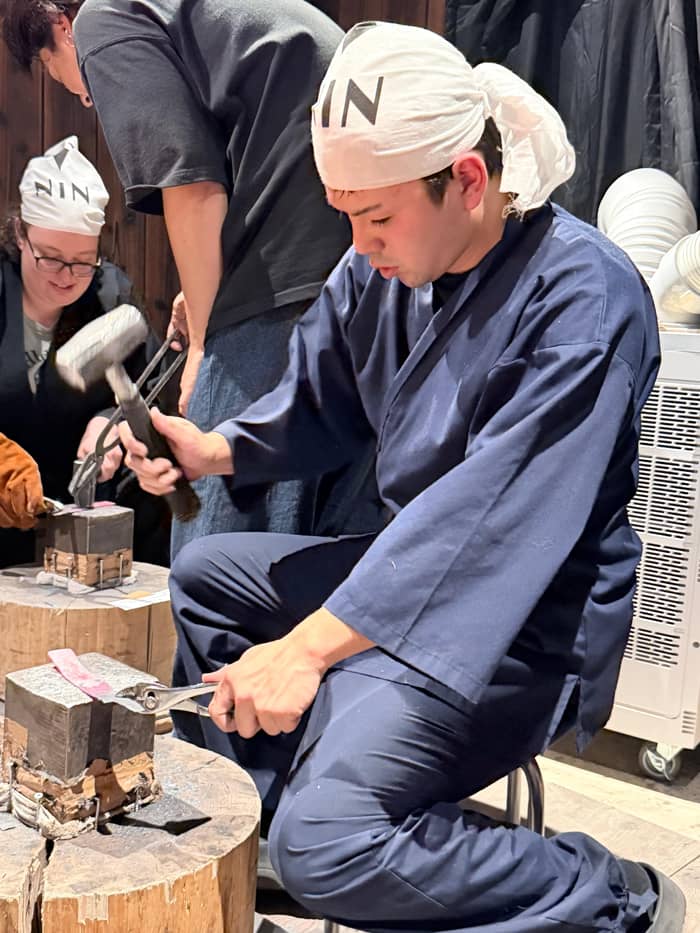
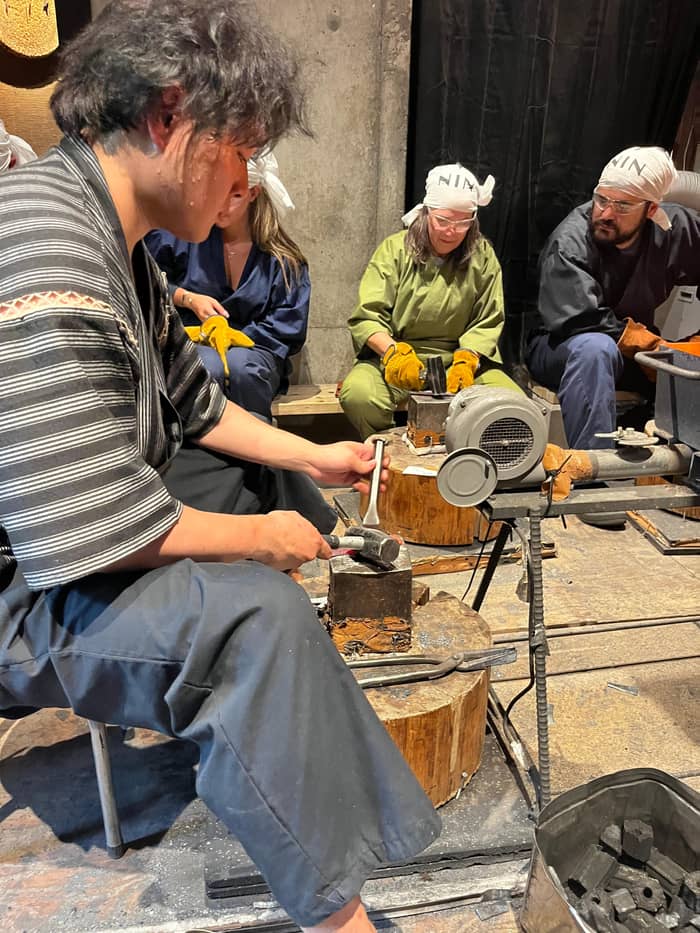
A longer option is the 2-hour handle-fitting session, limited to 3 guests, with an instructor who speaks English and Japanese. You choose the knife you want to work on, practise sharpening, fit its handle and take the knife home. It costs from $159. If you want to try forging first, our own class includes a sharpening step with stones and grinders before the polish. That makes it a way to meet sharpening inside a bigger project, not a dedicated lesson.
A reviewer of our class notes that a grinder was used for sharpening instead of a whetstone. That is worth knowing if you hope to learn stone work: ask which tools a class uses before you book it. Whichever session you pick, whether the stone or the machine, bring the lesson home to your own knives and keep the habits going once the trip is over; a skill like this lasts only if you keep using it.
FAQ
Shun says to hone regularly and sharpen only if the knife still feels dull after honing.1
Shun notes that some cooks hone once a week and others every day.12
It says a stone keeps the edge at your preferred level and can repair edge damage.3
Masamoto Sohonten also places a wet cloth under the stone to stop it slipping.7
Masamoto Sohonten says a burr you can feel with the ball of the finger shows the edge has formed.9
Aritsugu in Nishiki Market mentions repairs such as sharpening, and a Kyoto class teaches it from $63.17
Sources
Further reading
Wondering which Kyoto knife class suits you? A real person answers here.