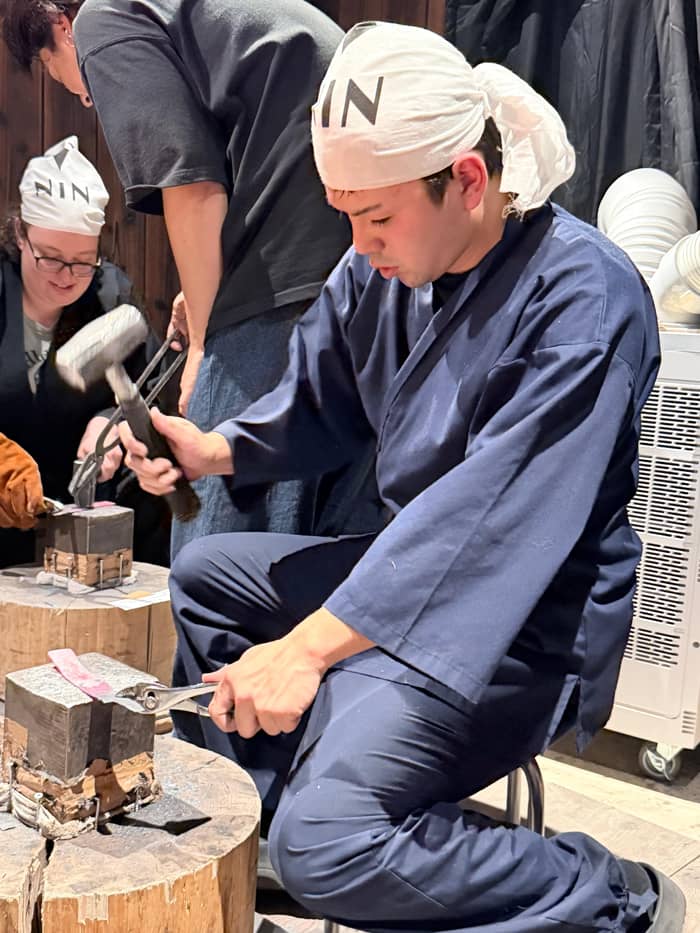
Make it
Forge a kitchen knife
Our listing
- LengthAbout 3 hours
- ResultA knife of 13 to 15 cm
- CancelFree until 24 hours before
Pick-for-me guide
Knife making at a blacksmith's forge in Kyoto
★ 4.9 · 800 opinions
Brief answer
Kyoto sword making is offered as a four-hour kogatana workshop in Kameoka, while the knife class forges a kitchen knife of about 13 to 15 cm in 3 hours.
Before you book
Two taps to a blade day
Say what you want to do with a blade and how long you have; the matching listing or museum appears.
Best choice for you
from $152
It forges a kitchen knife of about 13 to 15 cm in about 3 hours, not a sword; 800 reviews, rated 4.88.
Best choice for you
from $64
It lasts 1.5 to 2 hours, takes up to 10 guests and ends with a costume photo session; rated 4.84 from 807 reviews.
Best choice for you
from $62
It lasts 2 hours, takes up to 5 guests and includes a free history tour at the Samurai & Ninja Museum.
Best choice for you
from $114
It lasts 2 hours in a former samurai residence and pairs sword handling with meditation; rated 5.00 from 36 reviews.
Kyoto sword making is a living trade with a long history, but a visitor's options are narrower than the name suggests. This guide separates forging classes, sword lessons and museums, and covers what may leave Japan.
Editorial team, knifemakingkyoto.com · Updated November 6, 2026 · 8 min reading time
Basics
Search for Kyoto sword making and the results blur three activities: forging a blade, learning to wield one, and looking at old ones. They are different. The class we link to forges a kitchen knife, about 13 to 15 cm long, using the same traditional process as Japanese kitchen knives, and it runs about 3 hours. It is the nearest everyday option to smithing, but it is not a sword.
A real blade-forging workshop does exist near Kyoto. Japan's tourism board describes a four-hour workshop in the castle town of Kameoka, 25 minutes from central Kyoto, where a veteran swordsmith teaches visitors to craft a 15-cm miniature katana called a kogatana.1,2 The board adds that the workshop is conducted in Japanese by a swordsmith with limited English, and suggests an interpreter for a fuller experience.6
We do not list that workshop, and nothing on this page is a booking link for it. Treat it as a reference point for what a sword workshop involves. If you search for a Kyoto sword making experience, you will find listings that sound similar but teach swordsmanship, so read each listing's labels and check whether the guest forges anything at all before you book, and ask the organiser if the labels leave the point unclear.
Kyoto and nearby, side by side
| Activity | Length | What you do | From |
|---|---|---|---|
| Knife forging class | About 3 hours | Forge a kitchen knife | $152 |
| Kameoka kogatana workshop | Four hours2 | Forge a 15-cm blade, in Japanese1,6 | Not listed here |
| Samurai sword class | 1.5 to 2 hours | Bow, draw, cut; costume photos | $64 |
| Sword experience with museum | 2 hours | Museum history tour, star throw | $62 |
| Sword and zen | 2 hours | Sword handling and meditation | $114 |
Prices are from prices taken from each listing; the Kameoka workshop is described by JNTO and is not a listing we sell.1
Japan's tourism board describes the traditional process in stages. The starting steel, tamahagane, is smelted from iron sand and charcoal in a clay furnace called a tatara, with the team on hand for 72 hours.7 The smith then heats, hammers and folds the steel, up to 16 times, to combine iron and carbon and draw out impurities.8 Each stage depends on the one before it, so an error in the furnace or at the anvil shows up later in the finished blade, however carefully it is polished.
Next comes the clay. A coat of clay and charcoal protects the blade and gives it the wavy hamon, the temper line that shows after polishing, and the blade is fired to just below 815 degrees Celsius before quenching.9 A class of about 3 hours cannot hold all of this, and the Kameoka workshop forges a 15-cm blade instead.1 Visitors who want the whole story should remember that smelting, forging and polishing are separate stages, as the description above makes clear, and that a class touches only one.
Finally the blade goes to a polisher, whose work can take several weeks, sometimes months, before fittings are added.10 That span of time is a good reason to see a finished blade in a museum rather than expect a class to imitate the process. A class shows you the heat and the hammer, while a museum shows you what weeks of polishing and decades of skill can produce. The two together give a fair picture of the craft.
What guests have said
Counts come from the listings compared on this page; a larger count means more guests have rated an activity, not that it is better.
Kyoto's place in the story is long. The Kyoto National Museum says that three brothers who were swordsmiths, Kunitomo, Hisakuni and Kuniyasu, lived in the Awataguchi area of Kyoto from the end of the Heian period through the Kamakura period and founded the Awataguchi School.3 The museum adds that the brothers served the retired emperor Gotoba, and that Norikuni is said to have been a son of Kunitomo.3
The museum's long sword signed Norikuni gives a feel for the school's work. The museum describes the blade as slender, with a fine wood-grain texture on its surface and a narrow, straight temper line, features it says are characteristic of Kyoto swords of the early Kamakura period.12 If you visit the museum, the grain and the temper line are the two features to look for in a blade.
This history is why a forge class in Sakyo Ward carries some weight in Kyoto. The museum says the brothers served the retired emperor Gotoba, which puts Kyoto's smiths close to the court.3 Seki, in central Japan, offers another view: Japan's tourism board says some 300 swordsmiths worked there in the 1500s.13 Kyoto and Seki are both parts of a story in which the same trade forged blades first and kitchen knives later.
Pick your blade experience
Make it
Our listing
Hold it
Handling and cuts
See it
Tokyo, in Ryogoku
The Kyoto listings with sword in the title mostly teach handling. A class lasts 1.5 to 2 hours, takes up to 10 guests and has instructors who speak English and Japanese. You learn bowing, how to draw a sword and stylised cuts from a samurai master, then enjoy a costume photo session and receive a completion certificate. It starts from $64 and is rated 4.8 from 807 reviews. The listing asks you to wear clothes suited for exercise.
A smaller listing, the Kyoto Sword Experience, lasts 2 hours and takes up to 5 guests with an English-speaking instructor. It includes a free history tour at the Samurai & Ninja Museum and a ninja star throw, at the Kyoto branch. It starts from $62 with 41 reviews at 4.7. Another listing places the sword in a 260-year-old former samurai residence with zen meditation, 2 hours, from $114.
None of these listings mentions forging, so choose them for performance and atmosphere rather than for craft. They suit travelers who want to hold a sword-shaped object, wear traditional clothes and photograph the result. If your interest is the metal itself, the knife class is closer to the work of a smith, while the Kameoka workshop is closer still but requires some Japanese or an interpreter.
Work out the bill
Choose how many are coming and see the from price for each activity.
Side-by-side: 4 options
Choose how many are coming and see the from price for each activity.
≈
View≈
View≈
View≈
ViewStarting prices as on the booking platform, converted at the ECB reference rate. You see the exact price at booking.
A sword from ore to scabbard
Smelting
The team tends a clay furnace for 72 hours.7
Folding
The smith combines iron and carbon and draws out impurities.8
Coating
The coat protects the blade and shapes the hamon.9
Quench
The blade is fired and quenched, and it takes its curve.9
Polish
Polishing can take several weeks, sometimes months.10
Fittings
Metalworkers and carpenters fit the blade.10
The link between swords and knives is more than a metaphor. Japan's tourism board says that when demand for swords fell after the Meiji Restoration, craftsmen and manufacturers turned their efforts to knife making.17 It calls the art of Japanese cutlery a direct descendant of Japanese sword making, with many of the same techniques and designs still in use.11 That makes a kitchen knife forged in Kyoto a descendant of the blades above.
Sakai shows how a knife trade can grow from that history. Its forged blades were designated a Traditional Craft on March 5, 1982, and the work there is divided among a forger, a sharpener and a handle fitter.18,19 A Sakai walk from Osaka lasts 3.5 hours, visits a craft museum with a knife shop and a knife maker or blacksmith forge, and starts from $64. It is a day out from Osaka, not a Kyoto activity, so count the travel when you plan.
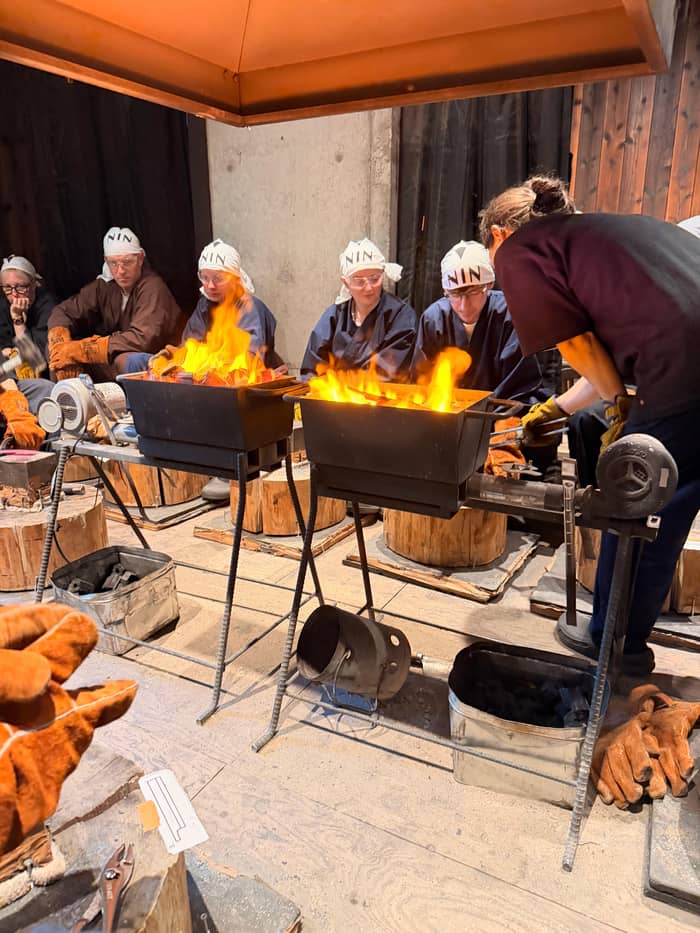
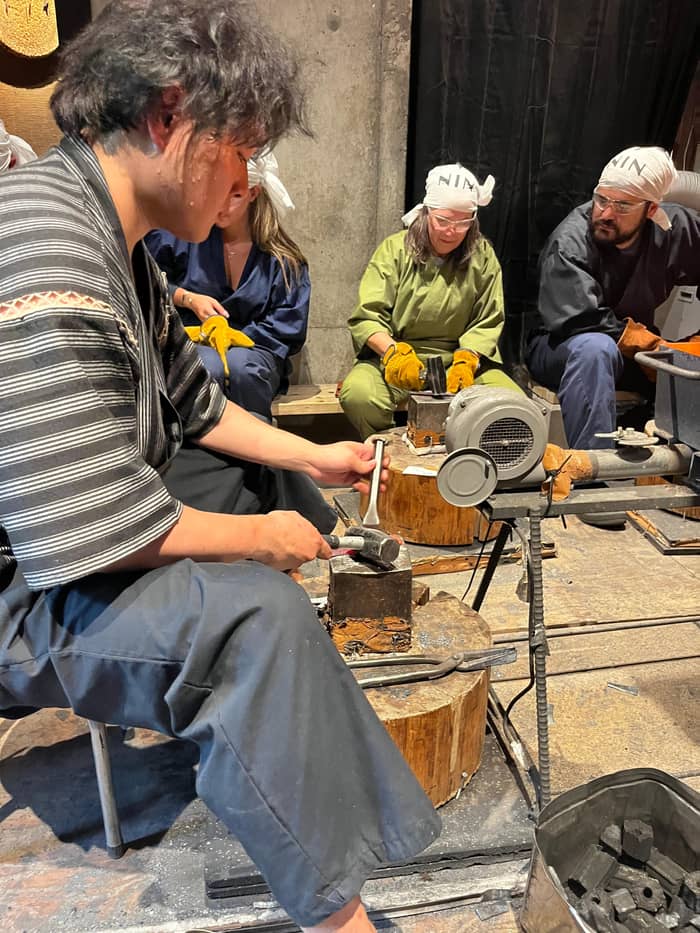
At the forge in Sakyo Ward the steps echo the sword's: heat the steel until it glows, strike it under close guidance, cool it and check the shape, sharpen, polish. The scale is smaller and the steel is simpler, but the rhythm is the same. If you like the idea of Kyoto sword making and cannot reach Kameoka, this is a well-reviewed alternative, with 800 reviews at 4.8, and it lets you finish with a blade you made and can use.
Video
Veritasium on YouTube · The video waits until you tap play to load.
Today, the art of Japanese cutlery is a direct descendant of Japanese sword making, with many of the same techniques and designs still being used.
Before you decide
The Kyoto National Museum holds blades, and its collection database includes the Norikuni long sword described above.3 Check the museum's own site for exhibition dates and opening hours before you go, because what is on view changes and a particular sword may not be on display. The database entry is a good way to learn the name and period of a blade before you stand in front of it, and it costs nothing to read the night before.
In Tokyo, the Japanese Sword Museum is open from 9:30 to 17:00, with last admission at 16:30.16 It is a 7-minute walk from the west exit of JR Ryogoku Station on the Sobu Line.20 If your trip ends in Tokyo, it makes a fitting finale to a Kyoto forge class, since it puts finished swords in front of you after you have spent an afternoon at the forge learning what the steel goes through before it becomes a blade, which is the best preparation for looking at one.
Whichever museum you choose, the trick is to look slowly. Notice the shape of the blade, the line of the temper pattern and the texture of the steel. Those are the same properties your own knife shows in a rougher form after the class. Seeing a sword in a case also makes it easier to understand why a polisher spends weeks on one blade, and why smiths treat their finished work as art.
A kitchen knife is a simple matter: ANA bars all blades from the cabin, and Kansai International Airport asks passengers to check in knives at the counter as checked baggage.14,21 A sword is different. Japan Customs states that possession of firearms, crossbows and swords is restricted by the Firearms and Swords Possession Control Law.4 The class listings here do not hand you a sword, so the question arises only if you buy one.
The Agency for Cultural Affairs says Japanese law as a rule prohibits the export of National Treasures, Important Cultural Properties and authorized important fine arts.22 Antique fine arts to be exported must carry a certificate showing they are not so designated, called Kobijutsuhin yushutsu kansa shomei and issued by the Agency.5 For a sword with value as a work of art, Japan Customs names a registration certificate issued by the Prefectural Board of Education among the import documents.23
The practical advice is short. If you want a sword, buy from a dealer who handles the paperwork and ask in writing what the Agency, customs and your home country require, before you pay. If you only want a keepsake, the knife you forge in a class is the simple route: sheath it, put it in the hold bag, and enjoy it at home.14,15 This page is not legal advice, so check the current rules with the authorities.
FAQ
The listing describes the traditional process used for Japanese kitchen knives.
The 1.5 to 2 hour class covers bowing, drawing a sword and cuts.
The Kyoto National Museum says three brothers founded it in the Awataguchi area.3
It is open 9:30 to 17:00, with last admission at 16:30.16
ANA bars all blades from the cabin.14
The Agency for Cultural Affairs requires a certificate for antique fine arts leaving Japan.5
Sources
Further reading
Wondering which Kyoto knife class suits you? A real person answers here.