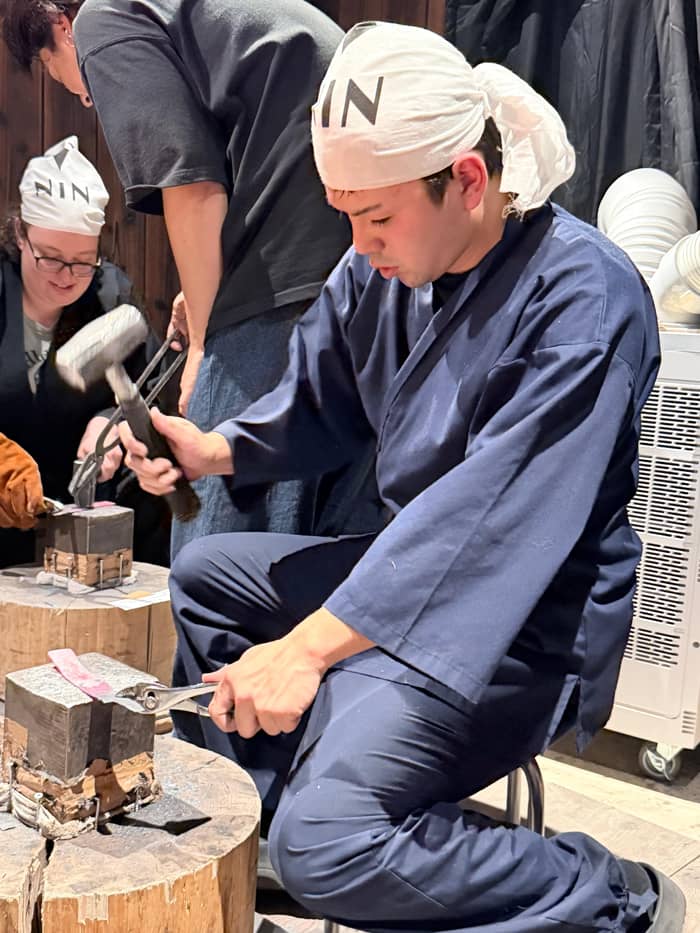
Hands on
Make one in Kyoto
Blacksmith studio session
- Time3 hours
- From$152
- GuideEnglish or Japanese
Tap-to-check list
Knife making at a blacksmith's forge in Kyoto
★ 4.9 · 800 opinions
Brief answer
A knife making experience at a blacksmith in Kyoto lasts 3 hours and starts from $152, with an instructor who speaks English or Japanese.
The craft in short
Checklist · 6 tasks
Tap to check items off; your progress is remembered on this device.
0 / 6 ready
Ready to go. Only the booking is left: your hammer and anvil in Sakyo Ward.
Claim a spotA Japanese kitchen knife passes through fire, hammer, water, stone and wood before anyone cuts with it. This guide follows every stage using the craft's official descriptions, so you know what you are looking at when you stand at the anvil.
Editorial team, knifemakingkyoto.com · Updated November 6, 2026 · 8 min reading time
Basics
A Japanese kitchen knife starts as a sandwich rather than a bar. Traditional makers forge-weld a hard carbon-steel cutting edge to a softer iron body.1 The pairing gives the knife a hard edge on top of a tougher supporting layer.5 Cut a finished blade across and the join shows: soft iron and steel bonded together, with the boundary line between them still visible.6 When a smith tells you the knife is laminated, this is the thing the word describes.
Regional smiths load the sandwich in different ways. In Tosa, in Kochi prefecture, a long groove is cut along the thin edge of an iron strip, the edge steel is inserted into the groove and lightly hammered, and boric acid is applied as an adhesive.7 In Echizen, in Fukui, a bar of iron has a groove cut in one side, and the steel blade is inserted and beaten with a hammer to join them.8 The Tosa description adds a reason worth remembering: placing hard steel between soft iron prevents the steel from breaking.9
Not every knife is a sandwich. Blades known as honyaki are forged from a single piece of steel, so the construction and the heat treatment change with the type of blade.10 Sakai's tourism bureau notes that professional chefs also use knives made only from steel.11 Some Tosa production centers now use a ready-made combination of steel and iron rather than welding their own.12 When you watch a blacksmith work, ask which of these methods you are seeing; the answer tells you how the finished knife is likely to behave.
Where it can go wrong
| Stage | What the sources warn about | Where it is said |
|---|---|---|
| Bonding | Too hot and the blade chips; too cool and ferrite and steel fail to bond20 | Sakai City |
| Hardening | A hard blade is brittle and will snap25 | Tosa craft sheet |
| Sharpening | Cooling water prevents warps and irregularities26 | Sanjo craft sheet |
| Storage | Hand-forged knives are weak to water and rust easily27 | Sakai tourism bureau |
| Hafting | Too much hammering can split the haft28 | Sakai City |
Each line is the source's own warning for that stage, not a forecast for your session.20
Everything in the forge is judged by color. As the metal heats it passes from cherry red through orange to white, and the artisan reads the temperature from that color.17 Sakai's tourism bureau says the same of its master craftspeople, who tell the optimal timing by the color of the fire.18 There is no dial in the picture, only years of looking. A smith teaching a beginner will keep saying not yet, or now, long before the beginner can see any difference.
The bonding weld is the opening test. Sakai's craft sheet has steel coated with boric acid, borax and iron oxide powder stacked on red-hot soft iron and softened in a furnace at about 900°C.2 Sakai's tourism bureau puts the forge for the same bonding stage at approximately 1000 degrees Celsius.19 The official descriptions differ on the figure, so read them as a working range rather than a dial setting.
The hearth is where a knife is won or lost. Sakai City says the hardest part of smith forging is keeping the hearth at the optimum temperature: if it runs too hot the blade chips easily, and if it runs too cool the ferrite and steel fail to bond.20 The fluxes matter as well. Boric acid goes on as an adhesive in Tosa, and borax and iron oxide powder do the work in Sakai, each helping the layers join rather than merely touch.7,2
Once welded, the plate is reheated and hammered out repeatedly to thin the metal, and the tang that will sit inside the handle is cut to shape.13 Tosa smiths call their method free forging, in which shapes are formed by hammering and flattening hot metal, and they describe it as the craft's distinctive trait.34 Artisans in this tradition can make any size or shape of blade in small production runs.35
Machines share some of the work. The belt hammer used in Tosa is a high-speed rotary machine hammer developed in the Showa period, and it helped raise production volume.36 Echizen uses double layering, in which two blade plates are layered and hammer-beaten on both sides.37 The hand hammer remains the tool you will picture and the tool a visitor is handed, but the craft has long used help from machinery.
After shaping, the knife is laid on a bed of straw and left to cool naturally, and the straw turning to ash helps remove internal distortions.14 Later, at room temperature, the blade is hammered again to flatten marks and tiny holes, fix distortion and give an even thickness.38 Both steps are about straightness. A blade that leaves the forge bent will not sharpen into a straight edge, and much of the rest of the process is about keeping it true.
Choose your angle
Each row points at the stage you care about and where the sources explain it
If I want to understand why knives are layered
Read the bonding stage
Hard steel on a softer iron body gives a hard edge with a tougher backing.5
If I want to know why a blade is reheated
Read hardening and tempering
Tempering adds durability and toughness to a brittle hard blade.25
If I want to understand edge angle
Read the grinding stage
The rough polishing step determines the angle of the blade edge.32
If I want the handle story
Read the fitting stage
Sakai hafts are rot-resistant magnolia wood, set with a wooden mallet.16,33
If I want to try it myself
Look at the Kyoto session
The listing runs 3 hours and starts from $152.
Ways to see a knife made
Hands on
Blacksmith studio session
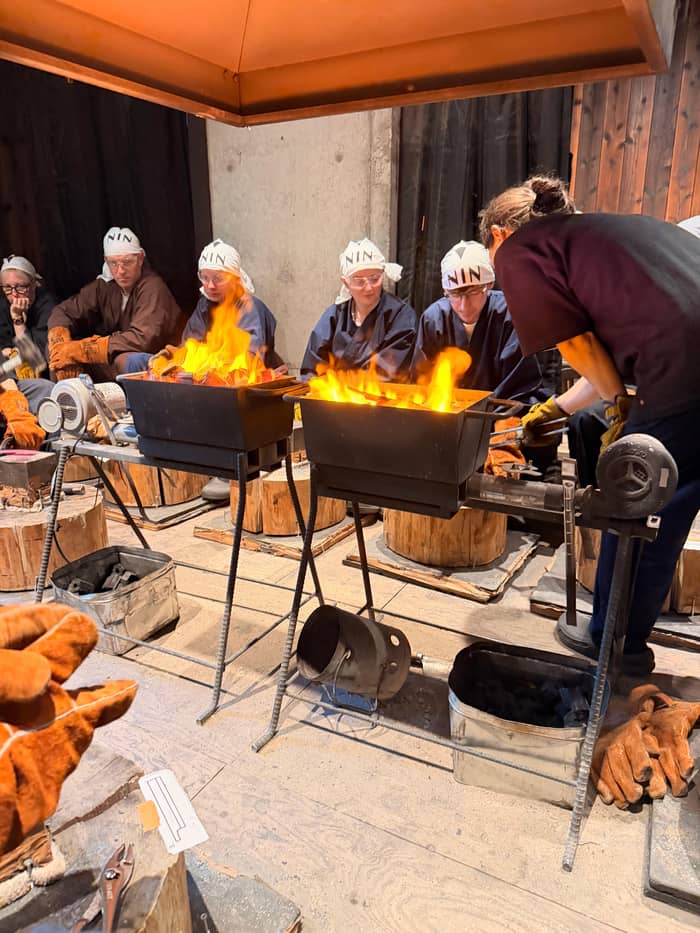
Stand and watch
Walking tour from Osaka
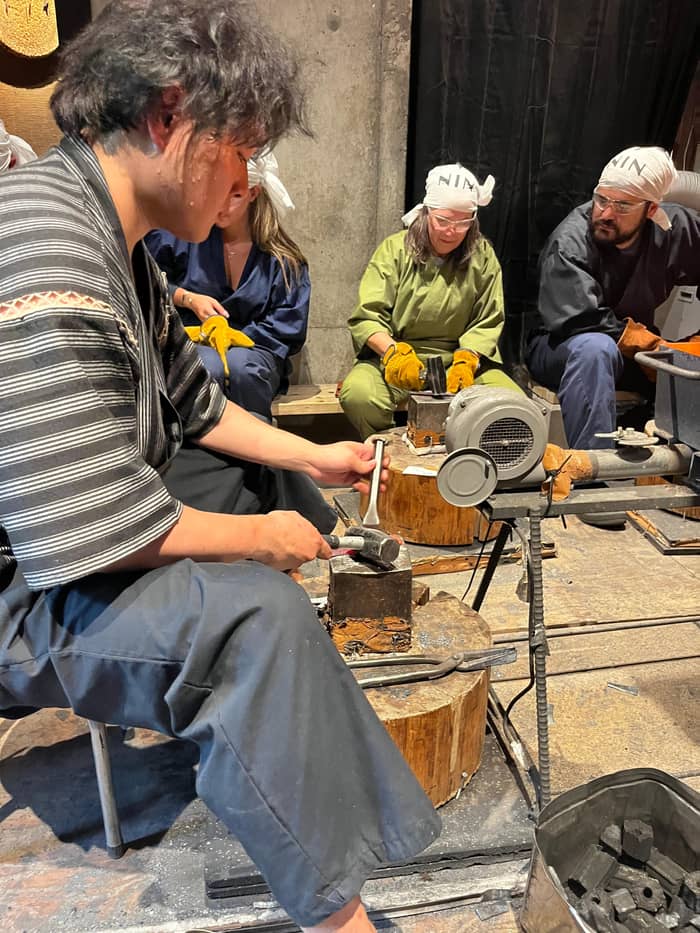
Free to look
Echizen factory and museum
See this choiceHardening is the moment a shaped piece of metal becomes a knife. Quenching is an important task that determines the hardness of the blade.39 Before it, the blade is coated with mud. In the Sakai sheet the mud prevents uneven heating and ensures quick, even cooling,40 and in Tosa it ensures good quenching.41 Sakai City describes layers of moist clay applied for the same job.42
The numbers are close from region to region. Sakai City heats the knife to 750 to 800°C and then quenches it in water.3 Tosa heats the blade in the hardening furnace at 770 to 800°C.43 Echizen coats the blade with mud, heats it at about 800°C and plunges it into cold water.22 Sanjo, in Niigata, heats at 780°C.23 Sakai's craftsmen judge when to stop heating by splashing water on the blade and watching how the droplets run.44
A hard blade is brittle and will snap, but tempering adds durability and toughness to the metal.25 Sakai City reheats the knife to 180 to 200°C and lets it cool naturally.4 Tosa's low-temperature tempering furnace is set to about 170°C.24 Echizen heats the blade at 150 to 220°C for about 30 minutes and cools it slowly.45 After both heat treatments, distortion is removed in Tosa by careful hammering of the face and back of the blade.46
The path of one blade
Bonding
Steel and soft iron are hammered together in a furnace at about 900°C.2
Shaping
The plate is reheated and hammered thin; the tang is cut for the handle.13
Cooling
The shaped knife cools naturally on a bed of straw.14
Hardening
The knife is heated to 750 to 800°C and quenched in water.3
Tempering
A gentler reheat to 180 to 200°C follows, then a natural cool-down.4
Finishing
A specialist sharpener uses a sequence of grinding stones to adjust the thickness, geometry and cutting angle of the blade for its purpose.15 Sakai City describes rough, intermediate and fine phases, each with progressively finer whetstones.47 The rough stage matters more than its name suggests, since it determines the angle of the blade edge.32
Polishing follows its own order: rough polishing, fine polishing, reverse side polishing, hazing and final polishing.48 In hazing, kneaded whetstone powder is rubbed on the blade, which gives the iron a flat subdued color and shines the steel.49 That contrast is what makes the join between iron and steel readable on a finished knife, and it is the reason a laminated blade looks the way it does.
Finishing touches differ by workshop. Sakai blades are etched with fine lines called metoshi that serve to prevent rust.50 Before the handle goes on, a rust-preventing oil is applied.51 In Echizen the sharpened part is dulled by a blurring machine and the edge is given a slight gap, which prevents loss of sharpness.52 Each detail is small; together they decide whether a knife reaches the cook sharp and stays that way.
Video
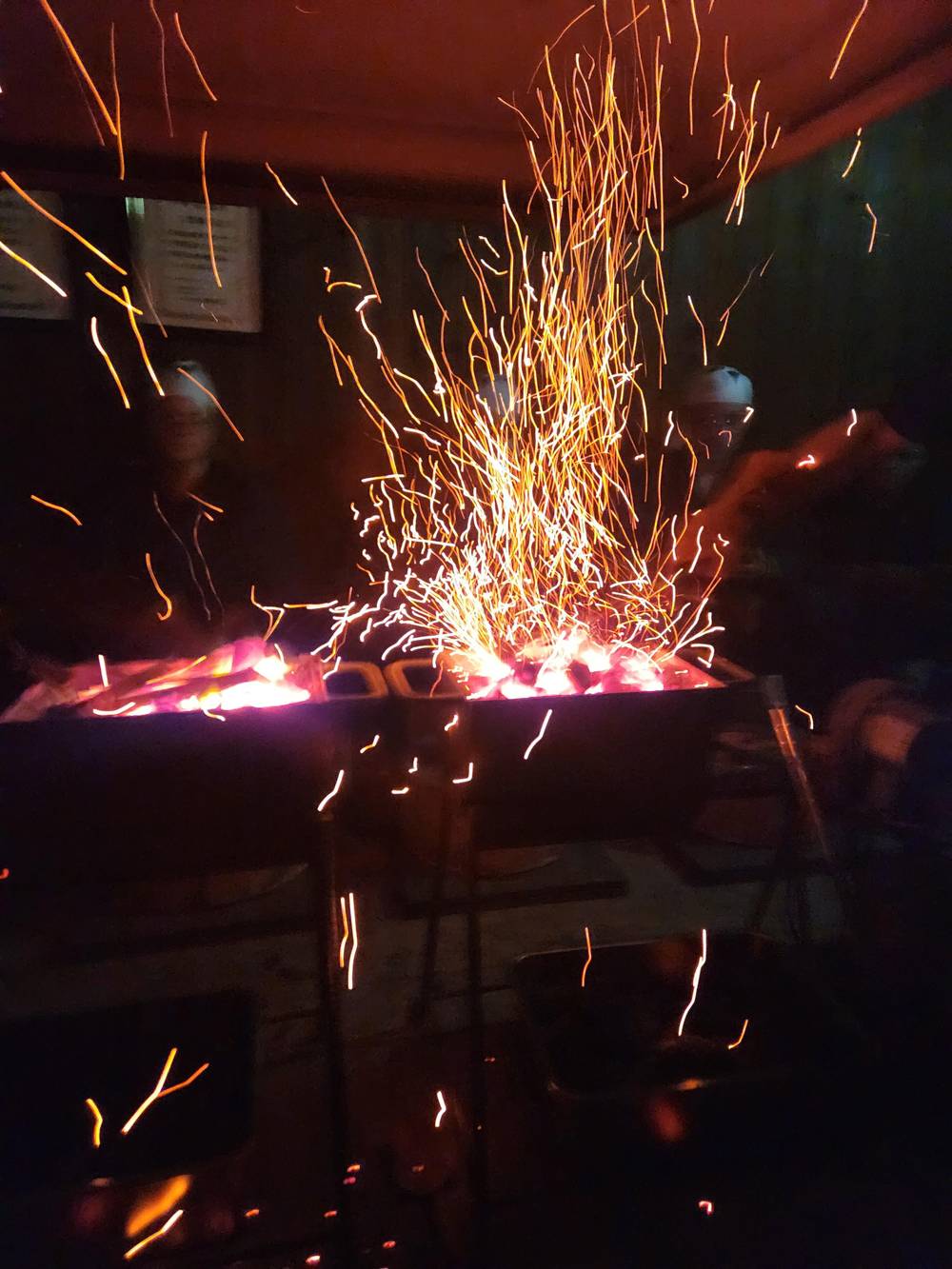
Life Where I'm From on YouTube · The video waits until you tap play to load.
A hard blade is brittle and will snap but tempering adds durability and toughness to the metal.
The handle is the last stage and the quietest. In Sakai the handle, also called a haft, is made of rot-resistant magnolia wood.16 The tang goes into it, and tapping the bottom of the handle with a wooden mallet causes the blade to go into the handle.33 If you have ever wondered how to make a Japanese knife handle, the honest answer is that the blade and the handle are made by different people with different tools.
Sound is the gauge. Sakai City says craftsmen listen to the sound of the blade at each stroke, because too much hammering can split the haft.28 When the fit is done the balance and alignment of the completed knife are carefully checked.53 A hammer and chisel then engrave the brand name, which completes the Sakai knife.54
Fit is not a luxury in this tradition. Sakai blades are made to a length and thickness the customer specifies, to within several millimeters.55 A knife that is specified that closely deserves a handle that sits true, and anyone fitting one for the first time should expect to spend more patience here than at the anvil. Rushing the handle undoes the care given to the blade.
The session behind this site is a Kyoto listing for an authentic knife making experience at a blacksmith. It lasts 3 hours and starts from $152, with an instructor who speaks English or Japanese. A small group is available, and the listing carries 800 reviews at a rating of 4.8. Free cancellation applies up to 24 hours ahead, and you can reserve now and pay later.
The listing places the meeting point in the Yase district of Sakyo Ward, a one-minute walk from the Yase-Hieizan exit of the Eizan Electric Railway. The operator runs a pair of studios in Sakyo Ward, and staff message guests before the visit to say which location to attend. Expect the day to start by the train line rather than in the middle of town, and plan the hours either side of the session around that.
Everything above describes the craft in general. The booking page is the place to confirm which of these stages your own session covers, and how much of the work you do with your hands. Treat the stages here as a map for any Japanese knife making workshop: they let you recognize what the smith is doing at each moment and ask better questions while it is happening. For a look at how a whole community makes knives, Takefu Knife Village in Echizen was completed in May 1993 as an open factory and shop.31 You can walk through its museum and factory for free, and its experience programs for the public need a reservation made in advance.29,30
FAQ
Many traditional kitchen knives are made by forge-welding a hard carbon-steel cutting edge to a softer iron body, then hardened, ground and fitted with a handle.1
A hard blade is brittle and will snap, but tempering adds durability and toughness to the metal.25
The color of the metal changes from cherry red to orange to white as it heats, and the artisan reads the heat from it.17
Its construction and heat treatment vary with the type of blade.10
Sakai City describes a haft of rot-resistant magnolia wood.16
The listing starts from $152, with English or Japanese instruction and free cancellation up to 24 hours ahead.
Sources
Further reading
Wondering which Kyoto knife class suits you? A real person answers here.