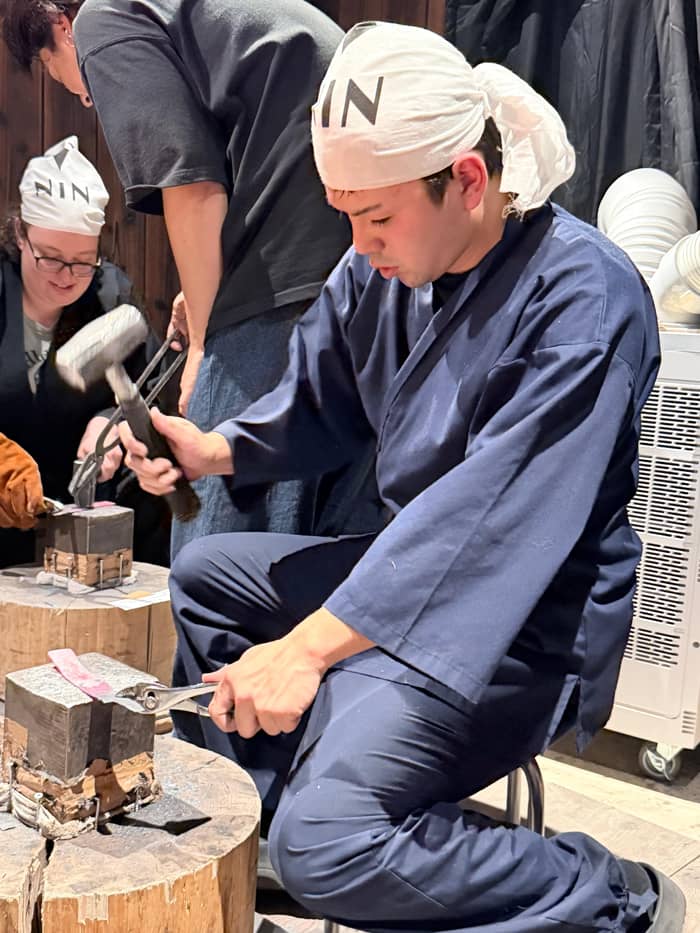
Hammer and fire
The forging class
Our listing
- LengthAbout 3 hours
- KnifeAbout 13 to 15 cm
- CancelFree until 24 hours before
Pick-for-me guide
Knife making at a blacksmith's forge in Kyoto
★ 4.9 · 800 opinions
Brief answer
Knife making in Kyoto ranges from 1-hour workshops to a 3-hour forging class, and the main difference between the classes is how much of the blade you make yourself.
Group sizes
Two taps to a class
Say how much of the knife you want to make and, for a short session, how much time you have; the matching class appears with its starting price.
Best choice for you
from $152
It runs about 3 hours and has you forge a knife of about 13 to 15 cm; 800 reviews, rated 4.88.
Best choice for you
from $61
It lasts 1 hour, takes up to 10 guests and covers shaping, assembling, sharpening and polishing; rated 4.90 from 279 reviews.
Best choice for you
from $159
It lasts 2 hours and takes up to 3 guests; rated 4.95 from 169 reviews.
Best choice for you
from $63
It lasts 1 hour and takes up to 6 guests; rated 4.81 from 24 reviews.
Knife making in Kyoto can mean hammering red-hot steel, shaping and polishing a blade, or learning to sharpen one. Here is how length, group size, price and what you take home differ, listing by listing.
Editorial team, knifemakingkyoto.com · Updated November 6, 2026 · 8 min reading time
Basics
Search for knife making in Kyoto and you find listings that share a name but not a job. At one end sits a smith's studio where you heat steel and strike it. At the other sits a classroom where you shape a blank, sharpen it and polish it in about an hour. A third group teaches sharpening alone. The word knife is the same in all of them, so the useful question is how much of the blade you make yourself.
The craft has a long Kyoto link. Japan's tourism board says that when demand for swords fell after the Meiji Restoration, craftsmen turned their efforts to knife making, and it calls Japanese cutlery a direct descendant of sword making that still uses many of the same techniques.1,2 That history is why a forge class feels different from a polishing class, even though both end with a blade in your hand and a story for your kitchen shelf.
Every class below books through the same platform, which shows a from price, a rating and a cancellation rule for each listing. The table further down puts them in one row each. Read the length and group size first, because they decide how much time you spend with an instructor and how much of the knife is your own work. Then read what each class hands back at the end, and whether that item is a finished knife or practice on one.
Kyoto classes side by side
| Class | Length | Group and language | From |
|---|---|---|---|
| Forging at a studio | 3 hours | Small group option, English and Japanese | $152 |
| Knife craft in Gion | 1 hour | Up to 10, English | $61 |
| Finishing workshop | 1 hour | Up to 6, English | $68 |
| Sharpening and handle | 2 hours | Up to 3, English and Japanese | $159 |
| Sharpening class | 1 hour | Up to 6, English | $63 |
| Sakai walk from Osaka | 3.5 hours | Up to 10, English or French | $64 |
Every price is a from price taken from the listing, so the final fare depends on date and group.
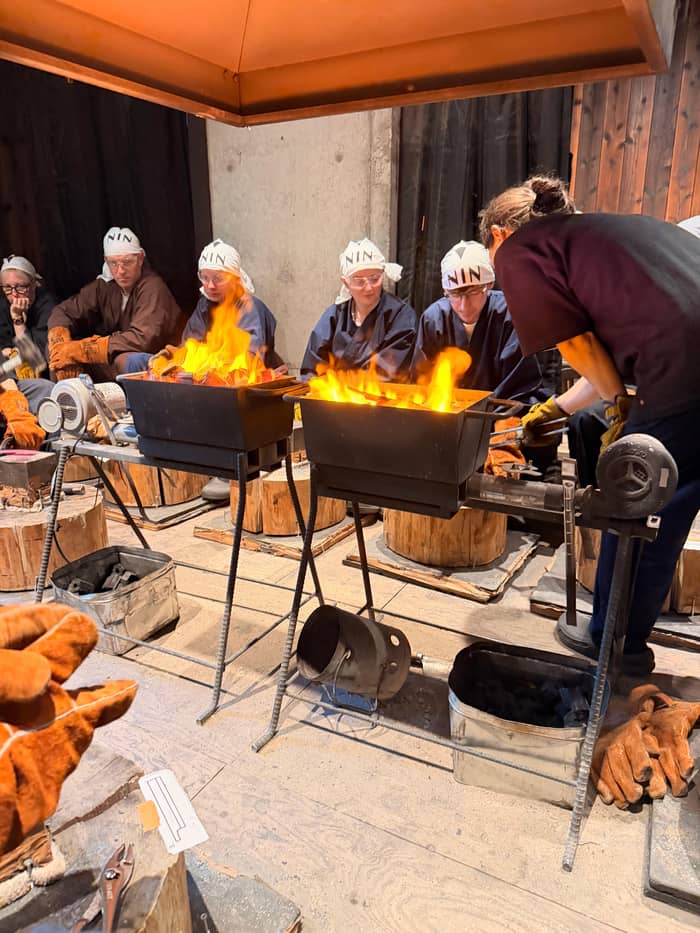
Our listing is the full forging route. It runs about 3 hours, and the instructors speak English and Japanese. You change into a smith's uniform, get a tools and safety introduction covering hammers, tongs and grinders, and hear how kitchen knives are traditionally forged before the steel goes into the furnace and heats until it glows. The listing says the hammering is guided closely.
After the forging, the blade is cooled and checked for shape, rough edges are refined, and you sharpen the knife with stones and grinders before polishing it. The finished knife is about 13 to 15 cm long and is yours to take home. Set your expectations around a keepsake that cuts, with a size to match, rather than a tool that replaces the knives already in your kitchen drawer at home.
The class has two studios in Sakyo Ward, Studio NIN Yase by default and Studio NIN Kendo depending on bookings, and staff message guests beforehand if the location changes. The Yase meeting point is a one-minute walk from the Yase-Hieizan exit of the Eizan Electric Railway, and the listing recommends the train. A reviewer who missed the message about the move still called the event fantastic, so read your booking messages the night before.
What guests have said
Counts come from the listings compared on this page; a larger count means more guests have rated a class, not that it is better.
If a smith's furnace sounds like too much, the 1-hour workshops are the lighter option. The Gion listing is a knife making workshop in Kyoto where you shape, assemble, sharpen and polish a kitchen knife step by step, with an English-speaking instructor and a group limited to 10. It carries the lowest from price among the Kyoto listings here, $61, and is rated 4.9 from 279 reviews. The workshop is held in a building's North block, above a car park, so allow a minute to find the entrance.
A Viator workshop covers similar ground as a finishing session. It lasts 1 hour, takes a group of up to 6 with a live guide in English, and starts from $68. Its rating is 4.9 from 359 ratings, of which 343 are five-star. The room is on the 4th floor of a building that also houses a curry restaurant, a useful landmark when you are looking for a door in a Kyoto side street.
Both options suit a trip where time is tight. An hour at a bench leaves the rest of the day free for temples or the market, and you do not need to change clothes or tolerate heat. The trade-off is plain: the work is finishing and sharpening rather than forging, so the story you bring home is about a polished edge, not about hammering steel at a furnace. Choose by the story you want, not just by the price.
Ways to make a blade
Hammer and fire
Our listing
1 hour
Shape and polish
Sharpen well
Small group
Some Kyoto listings treat sharpening as the main event. The handle-fitting session lasts 2 hours, caps the group at 3 and has an instructor who speaks English and Japanese. You choose the knife you want to work on, practise sharpening and fit its handle, then take the knife home, and you can ask in advance for engraved letters. It costs from $159 and is rated 4.9 from 169 reviews.
The sharpening class is shorter and cheaper. It lasts 1 hour, takes up to 6 guests, uses English, and is described as beginner-friendly: you work a dull blade into a sharp edge and learn how Japanese knives are built and how blade and sword culture fits in. It starts from $63, but only 24 reviews back its 4.8 rating, so treat the score as a small sample. The room is on the 3rd floor of a building across from a ramen shop.
Pick these if you already own a Japanese knife, or plan to buy one in Kyoto, and want to look after it. Sharpening is a skill you use at home for years, while forging is a single memorable afternoon. A later page on this site covers sharpening in more depth, so here the question is only whether a session of that kind earns a place in your itinerary next to the forge or the polishing bench.
Work out the bill
Choose how many are coming and see the from price for each style of class.
Side-by-side: 4 options
Choose how many are coming and see the from price for each style of class.
≈
View≈
View≈
View≈
ViewStarting prices as on the booking platform, converted at the ECB reference rate. You see the exact price at booking.
Our forging class
Arrival
You put on a smith's uniform and hear a tools and safety introduction.
Heating
The steel goes into the furnace and heats until it glows.
Forging
You strike the steel with a hammer under close guidance.
Refining
The blade is cooled, checked for shape and its rough edges are refined.
Sharpening
You sharpen the knife, then polish it.
Finish
You can ask about technique, history and knife care.
Put the Kyoto listings in a row and a pattern appears, even though the platform lists them under similar names. The forging class asks for the longest time, 3 hours, and costs from $152. The handle-fitting session takes 2 hours at from $159 with the smallest group. The 1-hour options sit between $61 and $68. In these listings the longer sessions and the smaller groups are the ones that cost more.
Group size is the quieter variable. A group of 3 gets an instructor's attention almost all the time, while a group of 10 shares it. Our listing does not state a cap beyond noting that a small-group option exists, so ask when you book if a private feel matters to you. Free cancellation up to 24 hours before applies to every Kyoto knife listing here, so booking a date early carries little risk.
The ratings tell a similar story to the review counts. Our forging class carries 800 reviews at 4.8, the Gion workshop 279 at 4.9, and the Viator finishing workshop 359 at 4.9. Every one of these is high, so the scores will not separate them. Use the review counts as a measure of how many guests have been through each format, and let your own preference between forging and finishing decide.
Video
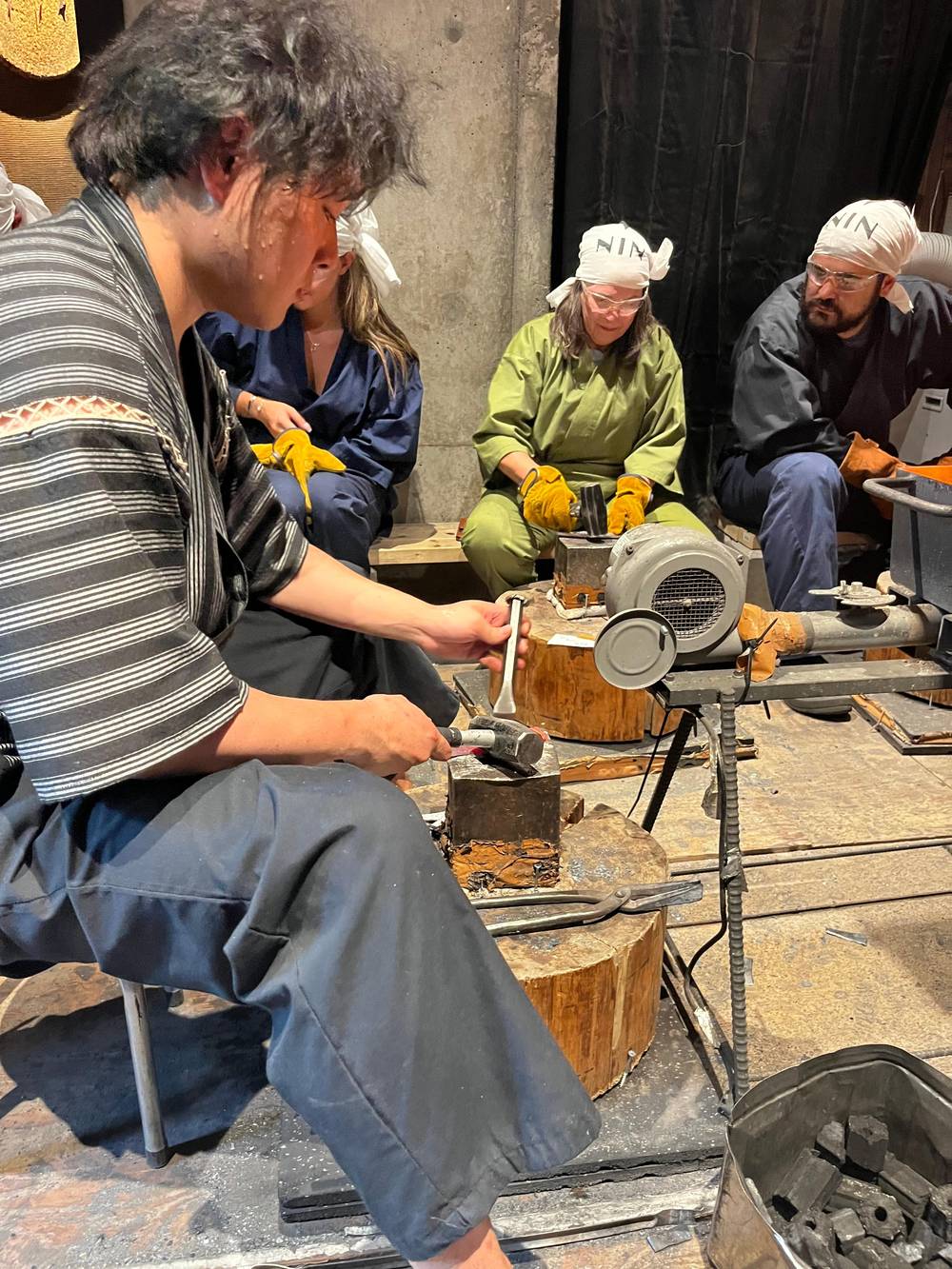
Beca on YouTube · The video waits until you tap play to load.
Today, the art of Japanese cutlery is a direct descendant of Japanese sword making, with many of the same techniques and designs still being used.
Before you book
Kyoto is not the only place to make a knife, and other listings send you elsewhere in Japan for a day. The Sakai walk from Osaka lasts 3.5 hours, takes up to 10 guests with a guide who speaks English or French, and visits the Sakai Traditional Crafts Museum and its knife shop plus a knife maker or a blacksmith forge. It starts from $64, and ordering a customised knife is optional.
Sakai is the knife town to know: its forged blades were designated a national Traditional Craft on March 5, 1982, and its makers split the work among a forger, a sharpener and a handle fitter.5,6 Seki is the other name you will meet: a one-day listing there has you draw on a Damascus blade, choose a Santoku, Gyuto, Nakiri or Bunka style, and eat lunch, for groups of up to 5 and from $318.
Tokyo and Osaka host knife classes too, which matters if your trip does not end in Kyoto. A 1.5-hour workshop offered in both cities has you sharpen the blade, fit the handle and engrave a name, from $159, while an Asakusa class lasts 1 hour from $91. If Kyoto is your only base, they are not worth a detour, but for a trip that ends in Tokyo they are a way to make the knife without the heat of a forge room.
A Kyoto knife making experience at a forge is a hot-room affair, and guests say so. Recent reviewers warn that the forge room runs hot, advise extra water, and suggest a change of clothes because you are sure to sweat. Another reviewer found the first hammering hard on the muscles, and says polishing afterwards was easy and relaxing. None of that is a reason to skip the class, but it is a reason to book a cooler part of the year or a morning slot if you tend to overheat.
The listing also states plainly that some of the work is dangerous, and that guests are responsible for any injury that happens. Children under 15 must be accompanied and protected by adults, which is a plain condition to weigh before you book places for a family group. For a family with younger children, check each listing's own age notes before you pay, because the conditions differ from class to class and the labels are brief.
A short guide to matching class to person: choose the forge if you want hammer, fire and a story; choose the 1-hour workshops if your day is full; choose the handle-fitting or sharpening sessions if you will cook with the knife afterwards. Whatever you choose, remember that ANA bars every blade from the cabin and Kansai International Airport asks passengers to check knives in at the counter.7,3 Pack your finished knife in the hold luggage, wrapped well, and your trip home is simple.
FAQ
The 1-hour workshops cover shaping, sharpening and polishing; the forging class runs about 3 hours and includes heating and hammering the steel.
These are from prices taken from each listing, so the final price depends on the date and the size of your group.
The listing also warns that some of the work is dangerous, so read it before you bring a child.
Reviewers suggest bringing extra water and a change of clothes.
The sharpening class is described as beginner-friendly, and the handle-fitting session is titled for beginners.
Our class uses two studios in Sakyo Ward, and a reviewer who missed that message arrived at the wrong one.
Sources
Further reading
Wondering which Kyoto knife class suits you? A real person answers here.